Published: August 9, 2026 | Category: India News & Analysis | Reading Time: 7 minutes
India is currently going through one of its most eventful stretches in recent memory. Three separate but overlapping stories are dominating headlines: a wave of youth-led protests demanding accountability from the government, intense national policy debates triggered by those protests, and an active, unpredictable monsoon system bringing heavy rainfall alerts across several states. This post breaks down what’s happening, why it matters, and what to watch next.
1. The Youth Protest Movement: From Exam Leaks to a National Reckoning
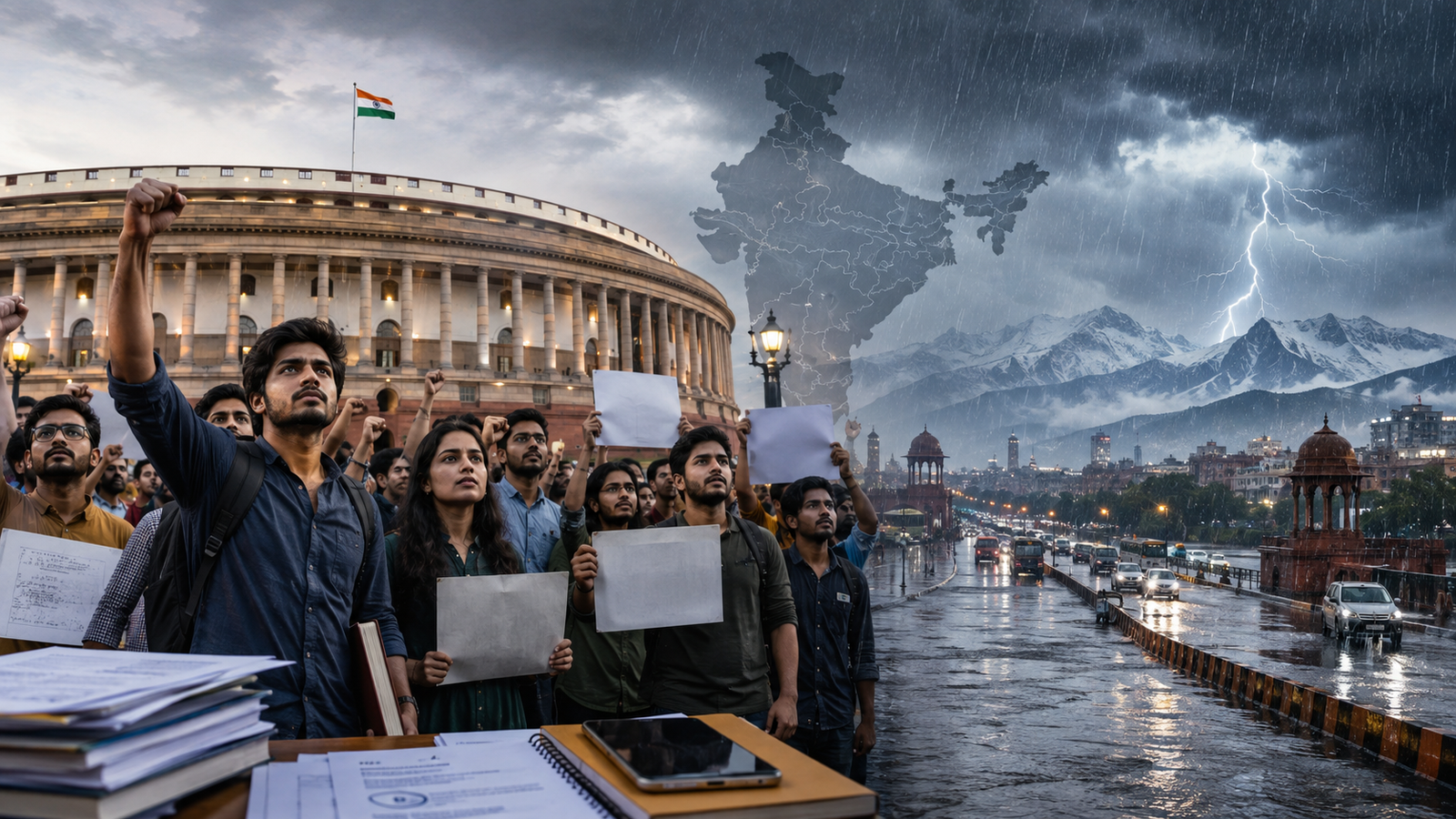
What began as anger over leaked national-level entrance exam papers has grown into the country’s largest Gen Z-led protest movement in years. Frustration over exam mismanagement combined with long-simmering concerns about youth unemployment and government accountability, pulling tens of thousands of students and young people onto the streets of New Delhi.
A satirical online group gained massive traction after a remark by a senior judicial figure was seen as dismissive of unemployed youth. What started as internet meme culture quickly evolved into a genuine grassroots political movement, with organizers calling for a peaceful march toward Parliament. The protest site at Jantar Mantar became the symbolic center of the demonstrations.
The pressure ultimately led to a major outcome: the resignation of a senior union minister, seen as a rare and significant concession from the government. However, human rights observers have raised concerns about how the protests were handled, pointing to instances of heavy-handed policing, including the use of batons and tear gas, along with temporary internet restrictions in affected areas.
Why this matters for readers:
- It signals a shift in how young Indians are engaging with politics — less through traditional parties, more through decentralized, online-first movements.
- It has forced a conversation about youth unemployment that policymakers can no longer sideline.
- It sets a precedent for how future large-scale civic movements may organize and pressure the government.
2. National Policy Discussions Triggered by the Unrest
The protests have pushed several policy questions to the center of national debate:
- Examination reform — calls for stronger safeguards against paper leaks and greater transparency in how national entrance exams are conducted.
- Youth employment policy — renewed pressure on the government to address job creation for India’s large population of young graduates.
- Protest and policing guidelines — a growing debate on how security forces should handle large peaceful demonstrations, including questions around internet shutdowns during unrest.
- Political accountability — opposition parties have used the moment to question the ruling government’s responsiveness to public grievances, while the ruling party has pushed back, framing some protest actions as politically motivated.
These debates are likely to continue shaping parliamentary sessions and public discourse in the coming months, especially as young voters represent a growing share of the electorate.
3. Active Weather Systems: Monsoon Alerts Across India
While the political story unfolds, India’s monsoon season is also active and, in places, severe. The India Meteorological Department (IMD) has issued rainfall warnings for several regions:
- Northwest India (Delhi, Haryana, Chandigarh, western Uttar Pradesh) — heavy to very heavy rainfall linked to a low-pressure area over southwest Uttar Pradesh.
- Himalayan states (Himachal Pradesh, Uttarakhand, Jammu & Kashmir, Ladakh) — widespread to fairly widespread rainfall expected through mid-August, raising concerns about landslides and flash floods in hill areas.
- Southern states (Kerala, coastal and southern interior Karnataka) — very heavy rainfall likely over the next few days.
- Rajasthan and eastern Uttar Pradesh — isolated heavy rainfall and thunderstorm activity expected through mid-August.
Nationally, cumulative monsoon rainfall has been running slightly below the long-period average, even as certain regions face flood-level downpours. This uneven distribution is a pattern IMD is monitoring closely, with block-level rainfall data now available for more precise, localized forecasting.
Practical takeaway for readers: if you’re in Delhi-NCR, Himachal Pradesh, Uttarakhand, or Kerala, check IMD’s official alerts before travel, especially through the second week of August.
Why These Three Stories Are Connected
At first glance, protests, policy, and weather might seem like unrelated news threads. But they intersect in real ways:
- Heavy rainfall has, at times, disrupted protest gatherings and travel for demonstrators.
- Government bandwidth is being split between crisis weather management (floods, landslides) and responding to political pressure from the protest movement.
- Both stories are testing the same underlying question: how responsive and prepared is India’s governance system when multiple pressures hit at once?
What to Watch Next
- Whether the protest movement sustains momentum now that its immediate demand (the minister’s resignation) has been met.
- Any new policy announcements on exam reform or youth employment in the coming parliamentary session.
- IMD’s extended forecast for late August, particularly for flood-prone Himalayan and northern regions.